

Intelligent buoy system developed by SARTI-UPC awarded USECIM Silver Award to improve beach safety
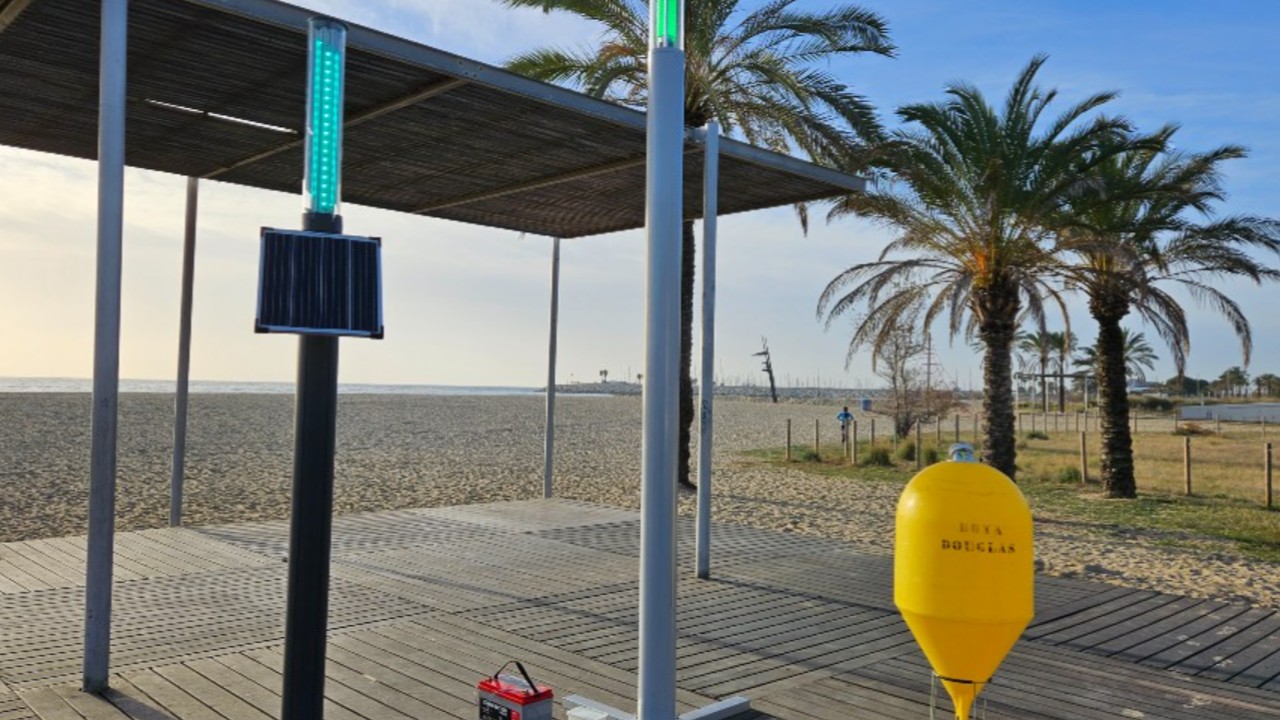
Last month, The Directorate General for Civil Protection of the Government of Catalonia has been awarded the USECIM Silver Award at the 6th edition of the USECIM Awards for the project “Automatic system for signaling and monitoring sea state using smart buoys and LED beacons.” This recognition, in the R&D&I category, highlights innovative initiatives in safety, emergency management, and mobility.
The project was developed in collaboration with the company Ona Safe & Clean and the Universitat Politècnica de Catalunya, through the SARTI research group, responsible for the technological development of the system and the integration of oceanographic sensors and communications.
Technology for real-time sea state information
The system combines buoys equipped with oceanographic sensors with a light beacon installed on the beach that functions as a traffic-light system. This integration enables physical sea data to be translated into clear and immediate visual signals for users.
The buoys include sensors capable of measuring:
- wave height
- wave period
- wave direction
- water temperature
- GPS position
These data are automatically processed and converted into a color-coded signal (green, yellow, or red) visible from the shore, even under adverse weather conditions.
Improving safety in unmonitored areas
The system has been specifically designed to enhance safety in beaches and coves without lifeguard services or outside surveillance hours. In these contexts, it provides objective and continuous information about sea conditions, reducing reliance on manual signaling systems.
Additionally, the platform allows remote management of the system, enabling adaptation of the signaling to other risks such as:
- jellyfish presence
- dangerous currents
- pollution events
Validation along the Catalan coast
The system was validated through a pilot test during the summers of 2024 and 2025 in several locations along the Catalan coast, including Mataró, Roses, and Cambrils.
In 2025, the project was completed with the implementation of an integrated system in Vilanova i la Geltrú, where the connected buoy directly translates sea data into visual signaling on the beach.
The results have confirmed the technological feasibility of the system and its potential to reduce risks in bathing areas.