

ANB Sensors S Series: Long term Biofouling Deployment test at OBSEA
ANB Sensors has developed a cost-effective, smart, self-calibrating, and low-maintenance pH sensor suitable for various sensing platforms, including ocean monitoring. ANB has introduced a new prototype that sets it apart from other ocean sensors, positioning it as the preferred choice for long-term oceanographic pH monitoring.
Initial testing of the sensors took place in the UPC lab to ensure optimal performance before deployment. After successful lab tests, two sensors were deployed at OBSEA. Users praised the sensor's user-friendly firmware configuration before deployment and its minimal handling requirements.
One significant achievement from these tests was the favorable biofouling results. During the test the first sensor was set to periodic monitoring every hour, whilst the second sensor was placed in sleep mode. This meant that the sensor was not measuring pH during its deployment whilst the first sensor remained active. The sensors were periodically checked throughout the deployment. Figure 1 shows images of the S Series in deployment. It can be seen there is a clear difference between sensor 1 (A) and sensor 2 (B). When no sensing is being undertaken, sensor 2 (Figure 1B), there is bio growth across the whole sensor including the sensing element. However, in the case where monitoring was being conducted every hour, sensor 1 (Figure 1A), despite the sensors' bodies being covered in bio-growth after an 8-week deployment, the transducer surface of the active sensor remained clean. This underscores the sensor's resistance to biofouling. During the measurement operation of ANB’s revolutionary pH sensor, a small amount of hydrogen peroxide at the surface of the sensing element is produced. This inhibits the growth of biofilm on the surface of the sensor with any excess being broken down naturally in the local environment.
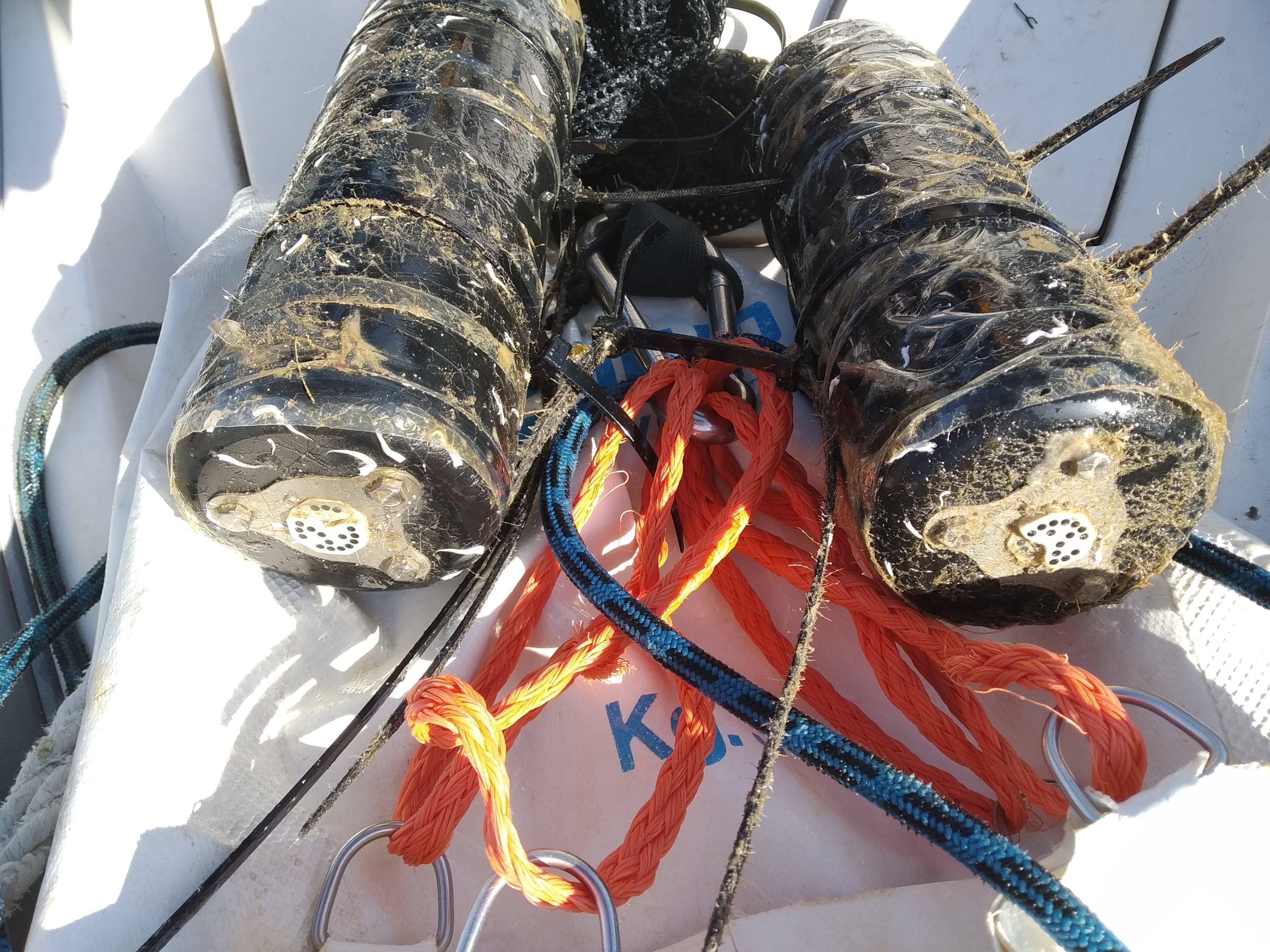
This result was confirmed when the sensors were removed from deployment and images of the sensors were taken. Figure 2 shows the two sensors (sensor 1 – right hand side, sensor 2 – left hand side) at the quayside after deployment. Both sensors show biofilms along the sides of the sensor however, there is no growth on sensor 1 and a thin film on sensor 2.
This data shows the robustness of ANB Sensors pH sensor to be placed in longterm deployments with minimal impact of bio growth.
Funding projects:
S1100-Bio, ANB Sensors S Series: Longterm Biofouling Deployment. 1ST TNA JERICO-S3 CALL
ANB Sensors Calibration-free pH Sensors: Long term deployment for biofouling investigation of the new sensor OC300. EMSO TNA 2022 CALL
| A | B |
|
|


Figure 1: Images of the ANB’s S Series sensor when it was deployed for 8 weeks when A) the sensor was monitoring every hour and B) when the sensor was in sleep mode

Figure 2: Images of the sensors after
deployment the sensor set to monitoring every hour is on the right hand side
and the sensor set to sleep mode on the left hand side.